
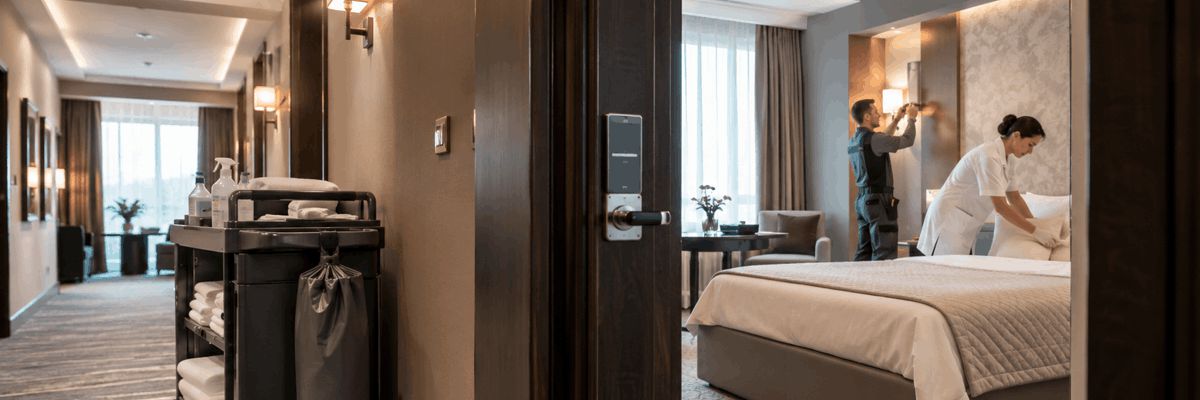
Room Downtime in Sanatoriums: Causes, Tracking, and Loss Reduction
Room downtime is one of the hidden sources of operational and financial loss in a sanatorium. A room may remain unavailable not only because there is no booking, but because it is not ready for the next guest: housekeeping is delayed, a defect has been found, repair work is pending, or the room status has not been updated in time.
For European sanatoriums, wellness resorts, rehabilitation centres, and medical hospitality facilities, room availability is closely linked to treatment schedules, guest arrivals, meal planning, medical appointments, and internal service coordination. When rooms are not returned to use quickly, the organisation may lose revenue, create pressure on reception staff, and reduce the quality of guest service.
SandSoft software for housekeeping helps sanatoriums manage these processes in a single operational environment. It connects housekeeping tasks, room statuses, defect reporting, and maintenance requests, so reception, housekeeping, and technical teams work with current information instead of manual calls, spreadsheets, or paper lists.
What room downtime means in a sanatorium
Room downtime is the period when a room cannot be used for accommodation or does not generate the expected value for the facility. In practice, downtime is not always caused by low demand. A room may be free in the booking system but still unavailable for check-in because it has not passed the required operational stages.
Commercial downtime occurs when the room is ready but not sold. This is usually related to demand, pricing, booking channels, seasonality, or sales strategy.
Operational downtime occurs when the room is physically unavailable. For example, the previous guest has checked out, but housekeeping has not yet started. Or the room has been cleaned, but a defect has been found. Or maintenance has completed the repair, but the room has not yet been inspected and returned to ready status.
Administrative downtime occurs when the room is ready in reality but still marked as unavailable in the system. This may happen when statuses are updated late or when information is transferred manually between departments.
For management, the distinction is important. If the sanatorium only tracks occupancy, it may miss the internal causes that prevent rooms from being used efficiently.
Why room downtime creates losses
Room downtime directly affects the usable room stock. Even if demand is stable, a sanatorium may lose accommodation capacity because part of the room stock is delayed in housekeeping, repair, inspection, or status confirmation.
The loss is not limited to missed revenue. Room downtime can also lead to delayed check-ins, forced room changes, pressure on reception staff, guest dissatisfaction, and inefficient use of housekeeping and maintenance resources.
In a European wellness or rehabilitation facility, room readiness is often connected to a broader care schedule. Guests may arrive for planned treatment programmes, medical consultations, spa procedures, or long-stay rehabilitation. If the assigned room is not ready, the issue may affect several operational areas at once.
The key management problem is lack of visibility. If the facility does not record the exact reason and duration of downtime, it cannot understand whether losses are caused by housekeeping workload, recurring defects, delayed repairs, poor coordination, or inaccurate room statuses.
Main causes of room downtime
Room downtime usually appears at the point where several services meet. Reception needs accurate room availability. Housekeeping needs a clear task list and priorities. Maintenance needs timely defect reports. Management needs reliable data on delays and responsible departments.
Typical causes of room downtime include:
- delayed housekeeping after guest departure;
- late transfer of the room from dirty to clean status;
- defects found during cleaning or inspection;
- waiting for a technician, spare parts, or approval;
- long-running planned or unplanned repair work;
- missing deadlines for maintenance requests;
- incorrect room statuses in the system;
- poor coordination between reception, housekeeping, and maintenance.
A downtime case is often not caused by one large failure. More often, it is created by a chain of short delays. The room waits for cleaning, then a defect is found, then the technician is informed late, then the repair is completed but the room still requires final cleaning or inspection. Each delay may seem minor, but together they can lead to several lost hours or even a full lost room-day.
How housekeeping affects room downtime
Housekeeping is one of the most important factors in room readiness. After check-out, the room cannot be offered to the next guest until it has been cleaned, inspected, and assigned the correct status.
Downtime increases when housekeeping teams do not see real priorities. For example, a room needed for an early afternoon arrival may remain in the same queue as rooms required later in the day. If task distribution is manual, the head housekeeper may not immediately know which rooms must be cleaned first.
Another common issue is the lack of accurate time tracking. If the facility does not record when cleaning was assigned, started, and completed, it is difficult to understand where the delay occurred. The problem may be late task assignment, staff shortage, poor routing between floors, lack of linen, or a simple status update delay.
To reduce room downtime, housekeeping must be linked to room statuses. After check-out, the room should move into a status that clearly requires cleaning. When work starts, reception and management should see that housekeeping is in progress. After completion, the room should move to inspection, clean, or ready status depending on the internal process.
This creates a transparent operational chain: departure, cleaning, inspection, readiness, and return to available room stock.
Defects as a reason for room downtime
Defects are often found during housekeeping. A housekeeper may notice a damaged fitting, broken lock, faulty lighting, plumbing issue, furniture damage, heating problem, or missing equipment. If this information is passed by phone, paper note, or informal message, the defect may be delayed, duplicated, or lost.
Even a small defect can make a room unsuitable for accommodation. A leaking tap, broken bedside lamp, unstable chair, damaged shower fitting, or malfunctioning door lock may prevent the room from being assigned to a guest. If the defect is not recorded correctly, the room may remain in an unclear status: no longer only dirty, but not yet officially under maintenance.
Effective defect tracking should answer practical management questions. When was the issue found? Who reported it? Which room is affected? Is the defect critical for accommodation? Who is responsible for fixing it? What is the expected completion time? Has the room been returned to housekeeping or inspection after repair?
When these details are missing, downtime becomes difficult to control.
Repairs and maintenance in the room availability process
Maintenance must be connected to room downtime tracking. If repair work is managed separately from room statuses, reception does not see the true availability of the room stock, and management cannot measure how long rooms remain unavailable because of technical issues.
Planned maintenance should be scheduled in advance. Rooms can then be removed from the available room stock for a defined period, and occupancy can be planned accordingly. This is especially important for seasonal renovation, bathroom works, furniture replacement, heating system checks, and other work common in European wellness and rehabilitation properties.
Unplanned repairs require a faster process. A defect should immediately become a maintenance request. The request should have a responsible person, a priority, a status, and a target completion time. After the repair is completed, the room should not simply disappear from the maintenance list. It must return to the correct operational chain: final cleaning, inspection, and ready status.
Without this connection, rooms may remain unavailable even after the technical issue has already been solved.
Room statuses as the basis for downtime control
Room statuses are the operational language of room availability. Without accurate statuses, different departments may have different views of the same room. Reception may think the room is unavailable. Housekeeping may consider it cleaned. Maintenance may have completed the repair. Management may have no clear explanation for the delay.
For room downtime control, basic statuses such as occupied and vacant are not enough. A sanatorium needs intermediate statuses that reflect the actual path from guest departure to readiness.
Useful room statuses may include:
- guest checked out;
- dirty room;
- housekeeping assigned;
- housekeeping in progress;
- inspection required;
- clean room;
- ready for check-in;
- defect reported;
- maintenance assigned;
- repair in progress;
- sanitary treatment;
- temporarily unavailable.
The more accurately statuses reflect real work, the easier it is to identify the cause of room downtime. If a room remains in dirty status too long, the issue may be housekeeping workload or task prioritisation. If it stays in repair status, the issue belongs to maintenance. If it is clean but not available for check-in, the problem may be inspection or status confirmation.
How to track room downtime
Room downtime should be tracked as a management indicator, not as a simple note. It is not enough to know that a room was unavailable. The facility needs to know why it was unavailable, how long the downtime lasted, and which process caused the delay.
A practical downtime record should include the room number, building, floor, room category, start time, end time, reason for downtime, previous and current room status, responsible department, responsible employee, related housekeeping task, related defect or maintenance request, lost room-days, and estimated revenue impact.
This level of tracking helps separate objective downtime from avoidable operational losses. A long planned renovation may be necessary and expected. A room unavailable for several hours because a minor defect was reported late is a different type of loss. It can be reduced by improving process discipline and communication.
Indicators that help reduce room downtime
Reliable indicators allow management to see patterns rather than isolated cases. This is important because room downtime often repeats in the same buildings, room categories, floors, or operational steps.
Key indicators include:
- number of downtime cases per period;
- average downtime duration;
- downtime by building, floor, and room category;
- share of downtime caused by housekeeping;
- share of downtime caused by defects;
- share of downtime caused by repair work;
- average time from check-out to cleaning completion;
- average time from defect report to repair completion;
- repeated defects in the same room;
- number of rooms in unavailable status;
- estimated lost revenue for the period.
These indicators support operational decisions. If most downtime is related to housekeeping, the facility may need to review task allocation, staffing, and cleaning priorities. If downtime is mainly caused by repairs, management should analyse maintenance response time, spare parts availability, and repeated defects. If rooms are ready but still unavailable in the system, the issue is status control.
How sanatoriums can reduce room downtime
Reducing room downtime begins with a single controlled process. A room should not be lost between check-out, cleaning, defect detection, repair, inspection, and return to availability. Every stage should have a responsible person, a visible status, and a clear next action.
Reception and housekeeping must work with the same room availability data. Reception should see which rooms are dirty, which are being cleaned, which require inspection, and which are ready for check-in. Housekeeping should see priorities based on upcoming arrivals, room categories, buildings, floors, and operational urgency.
Defect reporting should be immediate. If a housekeeper or inspector finds an issue, it should be recorded at once and transferred to maintenance. The room should receive the correct status, and the repair request should be visible until the issue is resolved.
The final step is just as important as the repair itself. After housekeeping or maintenance work is completed, the room must be returned to the available room stock through inspection and status confirmation. Without this final control, completed work may not reduce downtime in practice.
The role of SandSoft in managing room downtime
SandSoft helps sanatoriums manage room downtime by combining room statuses, housekeeping tasks, defect tracking, and maintenance requests in one system. This gives the facility a current view of room readiness and reduces dependence on manual communication.
For management, this creates transparency. It becomes possible to see which rooms are vacant, occupied, dirty, under cleaning, under repair, waiting for inspection, or ready for check-in. For reception, it reduces the need for repeated calls to housekeeping. For housekeeping, it gives clear priorities and task visibility. For maintenance, it creates structured requests with room context and completion status.
The value of such a system is especially high when downtime comes from many small delays. SandSoft helps identify these delays, assign responsibility, and return rooms to use faster.
Common mistakes in room downtime management
One common mistake is to track occupancy but ignore operational room availability. A room may be technically vacant but still unavailable, and this difference must be visible to management.
Another mistake is to manage housekeeping, defects, and maintenance separately. If housekeeping works from one list, maintenance from another, and reception relies on verbal updates, room status becomes unreliable.
A third mistake is not measuring downtime duration. Without start and end time, the facility cannot understand whether the main problem is task assignment, execution, inspection, repair, or final status confirmation.
Why room downtime should be linked to financial performance
Room downtime should be connected to financial indicators. A delay of several hours may look like a minor operational issue, but repeated delays across many rooms can reduce the effective room stock and create measurable revenue loss.
The financial impact can be assessed through lost room-days, average accommodation price, room category, season, and occupancy level. This is especially important during high-demand periods, group arrivals, rehabilitation programme cycles, and peak wellness seasons.
When downtime is measured financially, housekeeping, defect management, repairs, and room statuses are no longer treated as isolated internal tasks. They become part of revenue protection and service quality management.
Conclusion
Room downtime in a sanatorium is not only a sales or occupancy issue. A significant part of downtime is caused by internal operations: delayed housekeeping, unreported defects, slow repairs, inaccurate room statuses, and weak coordination between departments.
To reduce room downtime, a sanatorium must see the full path of each room from guest departure to cleaning, inspection, repair if needed, and final readiness for check-in. Every stage should be recorded, assigned, and reflected in the current room status.
SandSoft software for housekeeping helps manage this process systematically. When housekeeping, defects, maintenance requests, and room statuses are connected, the sanatorium can return rooms to use faster, reduce operational losses, and improve the quality of guest service.