
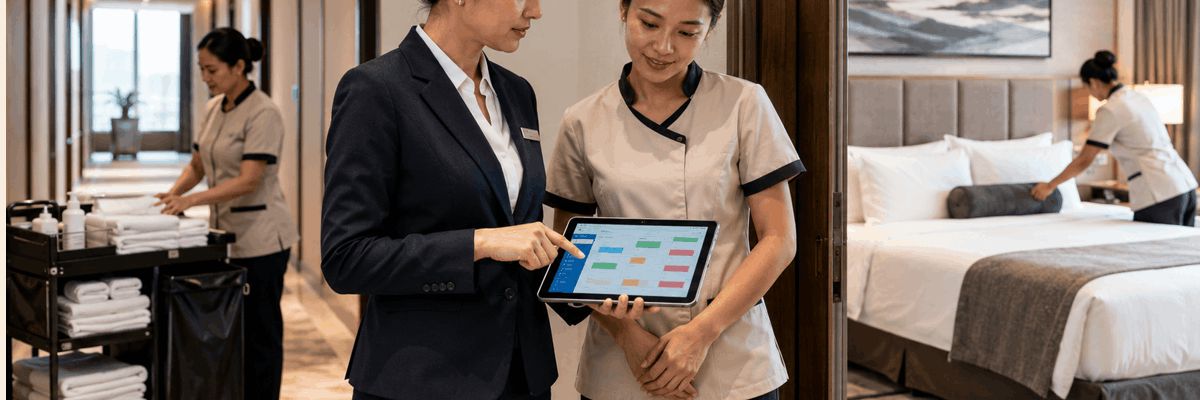
Maid shifts as the foundation of reliable housekeeping operations
Maid shifts are one of the core elements of effective housekeeping management. In a sanatorium, hotel, wellness resort or serviced residence, the quality of shift planning directly affects room readiness, guest satisfaction, staff workload and the coordination between housekeeping, reception and maintenance teams.
When maid shifts are planned manually or based only on fixed staff availability, housekeeping becomes vulnerable to daily operational changes. Early arrivals, late departures, group check-ins, medical treatment schedules, special guest requests and urgent cleaning tasks can quickly disrupt the original plan. As a result, supervisors spend too much time resolving conflicts, redistributing tasks and clarifying room statuses.
Comprehensive software for sanatorium automation helps make this process more structured and transparent. It allows managers to plan daily cleaning work, assign tasks to maids, monitor room readiness, control supervisor inspections and keep front office teams informed about the real status of each room. This is especially important for European sanatoriums and wellness properties, where guests often stay for longer periods and room service must be coordinated with treatment, rest and recovery schedules.
A well-organised maid shift is not just a working period. It is a managed operational unit with clear tasks, priorities, responsibilities and control points.
What maid shift planning includes
Maid shift planning covers more than preparing a staff rota. It connects long-term workforce planning with daily housekeeping operations. The schedule shows who is available to work, while the daily plan defines what exactly must be done during the shift.
In practice, maid shift planning includes staff availability, working hours, room occupancy, departures, arrivals, recurring cleaning, deep cleaning, special requests and room inspections. In sanatoriums, it may also include cleaning around treatment timetables, quiet hours, wellness procedures and specific requirements for guests with limited mobility.
The purpose of maid shift planning is to ensure that every room receives the right level of service at the right time. This requires a balance between planned work and operational flexibility. A fixed schedule may be convenient for administration, but it does not always reflect the real workload of the day.
Why housekeeping schedules should not be based only on staff numbers
A common mistake in housekeeping management is to plan shifts only by counting how many maids are available. This approach may look simple, but it does not show the true workload.
Two maids can receive the same number of rooms but have very different levels of difficulty. One employee may be assigned mostly departure rooms, large suites or rooms requiring detailed preparation. Another may work mainly with occupied rooms that need standard maintenance cleaning. On paper, both employees have the same number of rooms. In reality, their workload is not equal.
Effective housekeeping schedules must consider the labour intensity of each task. Departure cleaning, occupied-room cleaning, linen replacement, bathroom preparation, balcony cleaning, deep cleaning and post-maintenance cleaning all require different amounts of time. Room category, floor, distance from the linen room, guest condition and urgency also affect the workload.
For this reason, maid shifts should be planned according to actual task complexity rather than only the number of rooms.
Key data needed for effective maid shift planning
Accurate planning depends on reliable operational data. The housekeeping manager or supervisor needs a current view of room status, guest movements and staff availability before assigning work for the day.
The most important planning data includes:
- arrivals, departures and occupied rooms for the selected date;
- room categories, floor locations, room size and expected cleaning type;
- standard time required for different housekeeping tasks;
- employee availability, absences, replacements and working-hour limits;
- priority rooms, including early arrivals, group check-ins, VIP guests and rooms requiring special attention;
- pending maintenance issues, guest requests and rooms waiting for supervisor inspection.
This data makes the daily plan more realistic. It also reduces the need for urgent manual corrections during the shift. In larger properties, the absence of accurate data usually leads to uneven workload, delays in room readiness and unnecessary communication between departments.
Types of maid shifts in hospitality and sanatorium operations
Different properties require different shift models. The right structure depends on occupancy patterns, guest behaviour, staffing levels and service standards.
A fixed schedule may be suitable for small properties with stable occupancy and predictable cleaning needs. It is simple to manage but less effective when guest flow changes significantly from day to day.
A rotating shift model is more appropriate for hotels, sanatoriums and wellness resorts with variable occupancy. It allows the property to cover morning, daytime and evening tasks, especially when rooms must be prepared before standard check-in time or serviced during specific guest availability windows.
A flexible schedule works well when demand changes by weekday, season or treatment cycle. For example, a wellness resort may have more departures after the weekend and more occupied-room cleaning during the working week. Flexible planning allows managers to strengthen shifts during peak periods and reduce staffing pressure during quieter days.
A hybrid model combines regular shifts, duty staff and reserve capacity for urgent tasks. This approach is useful for larger European hospitality properties where guest requests, medical schedules, technical issues and last-minute room changes can affect the daily housekeeping plan.
Daily cleaning planning
Daily cleaning planning starts with the current room status. The supervisor needs to know which rooms are occupied, which guests are departing, which rooms must be prepared for arrival, which rooms are under maintenance and which rooms require additional attention.
The daily plan must translate this information into practical assignments. Each maid should receive a clear list of rooms and tasks, with priority levels and expected completion logic. The plan should also show which rooms need supervisor inspection before being released for guest accommodation.
In sanatoriums and wellness properties, daily cleaning planning must be sensitive to the guest’s routine. Some guests may attend procedures in the morning, rest in the afternoon or require cleaning at a specific time. This makes coordination more complex than in a standard short-stay hotel.
Daily cleaning planning should answer several operational questions: who is working today, which rooms must be cleaned first, which tasks are urgent, which rooms need inspection and which rooms can be marked as ready. Without this structure, housekeeping staff may work efficiently at the individual level but still fail to meet the property’s operational priorities.
Task allocation for maids
Task allocation is the point where the schedule becomes real work. A good allocation process ensures that every maid has a clear and balanced workload. It also helps the supervisor monitor progress and respond quickly if priorities change.
Tasks should not be distributed only by room count. They should be allocated according to cleaning type, estimated duration, room location, urgency and employee capacity. A departure room before early arrival should have a higher priority than a routine occupied-room cleaning that can be completed later in the day.
Task allocation should also take into account the physical route. If one maid is assigned rooms across several floors or buildings, time will be lost on movement. In a sanatorium campus, where accommodation may be spread across several wings or buildings, this factor can become significant.
A structured allocation process reduces confusion. Maids understand what they need to do, supervisors know what is in progress, and reception teams receive more accurate room-readiness information.
Priority management in housekeeping schedules
Not all housekeeping tasks have the same operational importance. Some rooms must be prepared immediately because guests are waiting or scheduled to arrive early. Others can be cleaned later without affecting the guest experience.
Priority should be clearly defined in the housekeeping plan. Early check-ins, group arrivals, VIP rooms, rooms after guest complaints, rooms after maintenance and rooms required for medical or wellness programme participants should be visible to supervisors and assigned staff.
If priorities are communicated verbally or through separate messages, they are easy to lose. A maid may complete a lower-priority room first while a critical arrival room remains unfinished. This creates pressure on reception and increases the risk of guest dissatisfaction.
Effective maid shift planning requires visible and updated priorities. When the room status changes, the plan should change with it.
The role of the housekeeping supervisor
The housekeeping supervisor is responsible for turning the daily plan into a controlled process. The supervisor monitors progress, supports maids, reallocates tasks when necessary, handles exceptions and confirms that rooms are ready for guests.
A room should not be treated as fully ready only because cleaning has been completed. In many properties, especially sanatoriums and higher-standard hotels, supervisor inspection is required before the room is released. This separates task completion from room readiness.
This distinction is important. If cleaning is finished but inspection is delayed, the room is still not operationally ready. If the room fails inspection, the issue must be corrected before the front office can safely assign it to a guest.
A clear inspection process protects service quality and helps identify where delays occur: during cleaning, during inspection, during maintenance or during status updates.
Common mistakes in maid shift planning
Many housekeeping problems are caused not by poor staff performance but by weak planning. When schedules, daily cleaning plans and task allocation are not aligned, even experienced teams may struggle to keep rooms ready on time.
Typical planning mistakes include:
- preparing maid shifts without considering arrivals, departures and occupancy levels;
- assigning tasks by room count instead of workload complexity;
- using no standard cleaning times for different task types;
- failing to reserve capacity for urgent requests and unexpected changes;
- relying on verbal instructions instead of a shared task plan;
- not separating cleaning completion from supervisor approval;
- updating room statuses too late for reception to act on them;
- ignoring workload imbalance, overtime and repeated delays.
These mistakes reduce control over the housekeeping process. They also create unnecessary pressure on supervisors, front office teams and maids.
Metrics for managing maid shifts
Maid shifts should be reviewed using operational indicators. Without measurable data, managers have to rely on impressions, complaints or manual observations. This makes it difficult to improve schedules and workload distribution.
Useful housekeeping indicators include the number of rooms cleaned per maid, average cleaning time, share of rooms ready on time, number of delayed tasks, number of rooms returned for correction after inspection, overtime by shift and the volume of urgent cleaning requests.
These indicators show whether schedules match the real workload. If overtime appears regularly on certain days, the shift structure may need to be changed. If rooms are often delayed after cleaning, the issue may be related to inspection capacity. If some maids are repeatedly overloaded, task allocation rules should be reviewed.
Data-based analysis helps improve both staff planning and service quality.
How automation improves housekeeping shift planning
Manual planning can work in a small property with a stable number of rooms and predictable guest flow. However, as the property grows or the workload becomes more variable, manual coordination becomes increasingly difficult.
Housekeeping automation helps connect schedules, room statuses, cleaning tasks, inspections and operational reporting in one process. Instead of relying on paper lists, phone calls or separate spreadsheets, the team can work from a shared and updated plan.
For sanatoriums, this is particularly useful because cleaning work often needs to be coordinated with longer stays, treatment timetables, guest rest periods and special service requirements. A digital plan helps supervisors adapt the schedule without losing control over priorities and responsibilities.
Automation also gives management a clearer view of performance. It becomes easier to understand how much work is completed during each shift, where delays occur and whether staff resources are being used efficiently.
Building a stable housekeeping planning process
A stable planning process requires both structure and flexibility. The property should define standard cleaning times, task categories, inspection rules and priority logic. At the same time, the housekeeping team must be able to react to real-time changes in arrivals, departures and guest requests.
Long-term schedules and daily plans should be managed separately but connected. The schedule determines which employees are available. The daily plan determines what they must do. When these two levels are disconnected, housekeeping becomes difficult to manage.
Managers should regularly review workload distribution, delayed rooms, overtime, inspection results and recurring operational problems. These reviews help refine future maid shifts and improve service reliability.
In European hospitality and sanatorium operations, this approach supports both guest comfort and labour discipline. It also helps maintain stable service standards during seasonal peaks, group arrivals and staff shortages.
Conclusion
Maid shifts are not only a staffing matter. They are a key part of housekeeping operations that affects room readiness, guest experience, staff workload and coordination between departments.
Effective planning requires accurate housekeeping schedules, clear daily cleaning plans, fair task allocation, visible priorities and reliable supervisor inspection. When these elements work together, the property can prepare rooms faster, reduce operational confusion and maintain consistent service quality.
Housekeeping Automation for Sanatoriums helps make maid shift planning more transparent and manageable. It supports task assignment, room-status control, supervisor checks and performance analysis, allowing the housekeeping team to move from manual coordination to a structured operational process.