
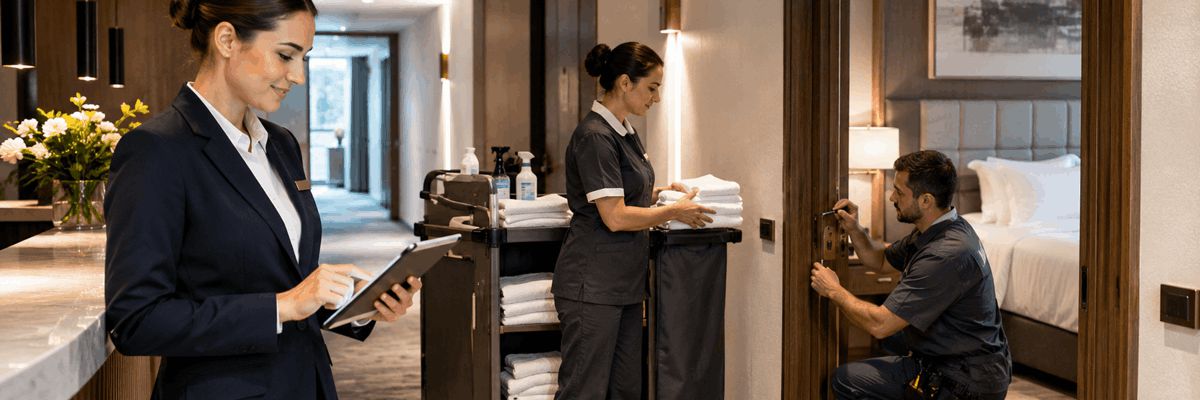
Room repair requests as part of a unified room operations process
Room repair requests and room cleaning requests directly affect room readiness, guest satisfaction, and the operational stability of hotels, sanatoriums, wellness resorts, serviced apartments, and other accommodation facilities. When reception, housekeeping, and the engineering team work in separate communication channels, tasks are delayed, information is duplicated, and room status becomes unreliable.
A unified request process solves this problem by connecting all room-related tasks in one controlled workflow. Each request receives a room number, task type, description, responsible employee, priority, status, and completion confirmation. This allows the property to manage not only individual tasks but the full operational cycle of room readiness.
For sanatoriums and wellness hotels, where room preparation may be connected with treatment schedules, early arrivals, mobility requirements, and longer guest stays, this process is especially important. Comprehensive software for sanatorium automation can be used to create a single working environment for reception, housekeeping, and engineering teams. It helps control cleaning, repairs, inspections, and room readiness without relying on paper logs, informal messages, or verbal instructions.
Why room cleaning and repair requests should not be managed separately
In many accommodation facilities, room cleaning requests are handled by housekeeping, while repair tasks are passed separately to the engineering team. Reception may receive a guest complaint, housekeeping may notice a defect during cleaning, and engineering may complete a repair without informing the employee responsible for final room inspection. This creates operational gaps.
A room can be marked as vacant but still require cleaning. It can be cleaned but blocked by a technical defect. It can be repaired but still need another inspection before being released for sale or check-in. If these events are not connected, employees may make decisions based on incomplete information.
A fragmented request process creates several common risks:
- reception does not see the actual room status before check-in;
- housekeeping receives urgent tasks too late or without clear priority;
- engineering does not always understand whether the repair blocks guest accommodation;
- managers cannot track overdue, repeated, or unresolved requests;
- rooms may be returned to operation without final quality control.
The issue is not only communication. The larger problem is the absence of a shared operational status for the room. A unified workflow allows all departments to work with the same information and the same sequence of actions.
How a unified room repair request workflow should work
A unified workflow means that every room-related request follows a clear path from creation to closure. The process may start at reception, in housekeeping, during supervisor inspection, or within the engineering team. Regardless of the starting point, the request must be visible to all relevant departments.
A standard room repair request should include the room number, category of issue, description, priority, creator, responsible employee, target completion time, current status, and final result. This structure prevents vague instructions such as “check the bathroom” or “something is wrong with the door.” Instead, the engineering team receives a clear task, and reception can see whether the room can be offered to a guest.
The workflow should support several operational scenarios. Reception can create a request after a guest reports a problem with lighting, heating, plumbing, furniture, or equipment. A housekeeper can create a repair request after finding a defect during cleaning. A supervisor can return a room to cleaning or engineering after inspection. An engineer can close the technical task and send the room for final housekeeping review.
This approach is especially useful in European wellness resorts and sanatoriums, where guests may stay for several days or weeks and expect stable room quality throughout the stay. It also helps properties with seasonal peaks, group arrivals, medical tourism programmes, and high occupancy periods.
The role of reception in room request management
Reception is often the first department to receive information that affects the room. A guest may report that the heating is not working, the shower is leaking, the safe is blocked, or additional cleaning is needed. Reception may also need to accelerate preparation for an early arrival or block a room after check-out until a technical issue is checked.
In a unified process, reception does not simply pass information by phone or message. The employee creates a structured request, assigns the correct task type, sets the priority, and monitors the status. This gives reception a reliable view of whether the room is ready, waiting for cleaning, under repair, or awaiting final inspection.
For front desk operations, this reduces the risk of offering a room that is not fully prepared. It also improves communication with guests. When the current task status is visible, employees can give clearer information about timing and avoid unnecessary escalation.
The role of housekeeping in room cleaning requests
Room cleaning requests are the core of housekeeping operations. After check-out, the room must be cleaned, checked, and returned to available status. However, cleaning is not always a standard task. Some rooms require urgent preparation, repeated cleaning after supervisor comments, additional towel replacement, special preparation for long-stay guests, or cleaning after maintenance work.
Housekeeping also plays a key role in identifying defects. Housekeepers and supervisors see the actual condition of rooms every day. They are often the first to notice damaged furniture, leaking taps, blocked drains, broken lighting, unstable door handles, malfunctioning climate control, or textile damage.
When these observations are added to a unified request process, the engineering team receives the task faster, and reception immediately sees that the room may not be ready for check-in. This prevents defects from becoming guest complaints and helps maintain a consistent quality standard across the property.
The role of engineering in room repair requests
The engineering team should receive room repair requests in a structured and traceable format. Verbal instructions are not reliable for operational control. They may omit important details, fail to show urgency, and leave no clear record of when the issue was reported or resolved.
Typical room repair requests may include:
- plumbing issues, including leaks, blocked drains, taps, showers, toilets, and water pressure problems;
- electrical issues, including lighting, sockets, switches, power supply, and in-room equipment;
- furniture, doors, locks, safes, fittings, handles, and interior elements;
- heating, ventilation, air conditioning, radiators, and climate control systems;
- minor repairs after guest departure, planned maintenance, or supervisor inspection.
After completing the repair, the engineer should update the request status. In some cases, the task can be closed immediately. In other cases, the room should return to housekeeping for cleaning or supervisor inspection. A technical repair may be complete, but the room may still be unsuitable for check-in until final preparation is confirmed.
Room statuses and request statuses
A unified process requires clear statuses. Without statuses, a request becomes only an instruction, not a managed task. Statuses show where the task is, who is responsible, and whether the room can move to the next operational stage.
For room repair requests and cleaning requests, the workflow may include these statuses:
- new request;
- assigned;
- in progress;
- waiting for materials, access, or specialist support;
- completed;
- requires inspection;
- closed;
- cancelled.
Room status should be connected to request status. A room may be vacant, occupied, waiting for cleaning, under repair, awaiting inspection, blocked from sale, or ready for check-in. This connection is critical because the room may be physically available but operationally unavailable.
For example, if a guest has checked out but the room has a broken lock, the room should not be released for sale. If engineering has fixed the lock but drilling dust remains near the entrance, housekeeping should receive a follow-up task. If the supervisor confirms that the room is clean and technically acceptable, only then should the room be returned to available status.
Priorities for room repair requests
Not every request has the same urgency. A broken lock, water leak, or lack of heating can block the room completely. A loose handle or cosmetic defect may need attention but may not prevent accommodation. Priorities help employees and managers understand which tasks must be completed first.
A critical priority means the room cannot be occupied until the issue is resolved. A high priority means the request must be completed before the next guest arrival. A medium priority is used for important tasks that do not immediately block room operation. A low priority is suitable for planned maintenance, minor defects, or improvements that can be handled during a less busy period.
Prioritisation helps the engineering team focus on tasks that affect revenue and guest comfort most directly. It also helps housekeeping and reception coordinate room preparation during busy arrival periods.
Returning the room to operation after cleaning and repair
Completing a request does not always mean that the room is ready for sale or check-in. After cleaning, the room may require supervisor inspection. After repair, the room may require additional cleaning, ventilation, replacement of linen, or a final technical check. Therefore, returning the room to operation should be treated as a separate control stage.
The correct process is based on confirmation. If no issues remain, the room receives the final ready status. If the supervisor finds a problem, the room returns to cleaning or repair. If engineering work is incomplete, the room remains blocked or marked as unavailable.
This is particularly important for sanatoriums and wellness hotels, where guests may have scheduled treatments, specific arrival times, or additional comfort requirements. A delay in room readiness can affect not only accommodation but the wider guest service cycle.
Performance indicators for request control
A unified request process gives managers reliable operational data. Instead of depending on verbal reports, the property can analyse actual response time, workload, recurring issues, and service delays.
Key indicators may include:
- average completion time for room cleaning requests, which shows how quickly housekeeping prepares rooms after task creation;
- average completion time for room repair requests, which helps assess engineering response and execution speed;
- number of overdue requests, which shows where service deadlines are not being met;
- share of repeated requests by room, which helps identify recurring technical defects or low-quality repairs;
- number of requests by category, which shows which types of defects are most frequent;
- workload by department and employee, which helps managers plan shifts and distribute tasks more evenly.
These indicators support better planning and preventive maintenance. If one category of repair requests increases, management can investigate the cause before it turns into a larger operational problem. If one floor regularly has delayed cleaning, staffing or process changes may be required.
Automation of room repair and cleaning requests
Managing room repair requests and room cleaning requests in spreadsheets, paper logs, and informal chats may work only for very small properties. As the room stock, staff size, and daily task volume increase, manual control becomes unreliable. Information is duplicated, request status is not updated on time, and the history of room issues becomes fragmented.
Automation creates a single operational workspace for reception, housekeeping, supervisors, and the engineering team. Employees can create requests, assign responsible staff, change statuses, track deadlines, and view the room history. Managers can see open tasks, overdue requests, blocked rooms, repeated issues, and employee workload.
For European hotels, sanatoriums, and wellness resorts, automation also supports a more consistent service standard. It reduces dependence on individual employees’ memory and makes the process easier to control across shifts, buildings, departments, and seasonal teams.
Business value of a unified request process
A unified process improves operational visibility and reduces service risks. Reception receives accurate information before check-in. Housekeeping works with clear room cleaning requests and priorities. Engineering receives structured repair tasks and understands whether the issue affects accommodation. Managers can control the process through statuses and performance indicators.
For guests, the result is a more predictable and comfortable stay. Rooms are prepared more reliably, technical issues are resolved before they become complaints, and additional requests are handled in a controlled way. For the property, this means fewer operational conflicts, better use of staff time, and more accurate control of the room stock.
A unified process also helps reduce revenue loss. When room status is updated correctly, management can see which rooms are blocked, why they are unavailable, and what must be done to return them to operation. This is important for properties with high occupancy, limited room availability, or scheduled group arrivals.
Conclusion
Room repair requests and room cleaning requests should be managed as part of one unified operational process. Reception, housekeeping, and engineering cannot work effectively if each department uses its own communication channel and its own understanding of room status.
A controlled workflow connects task creation, assignment, execution, inspection, and closure. Each request receives a responsible employee, priority, status, and completion result. The room is returned to operation only after the required cleaning, repair, and inspection stages are completed.
Housekeeping Automation for Sanatoriums can be used to build this process in practice. It helps combine cleaning requests, room repair requests, supervisor inspections, engineering tasks, and room readiness control in one system. As a result, accommodation facilities can improve service quality, reduce delays, and manage the room stock with greater transparency.