
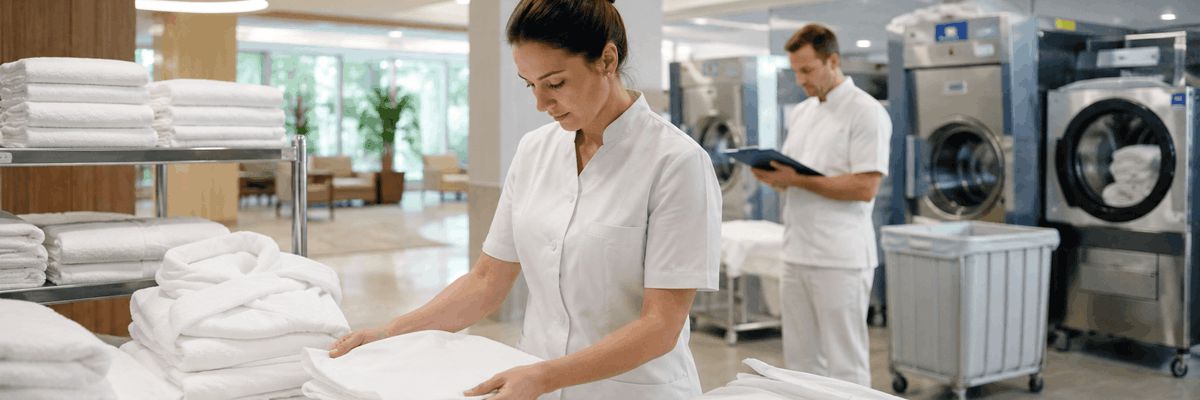
Laundry in a sanatorium as part of linen management
Laundry in a sanatorium is not just a technical service. It is a critical part of linen management that affects room readiness, hygiene standards, guest comfort, operating costs and the daily workload of housekeeping staff. Bed linen, towels, bathrobes, mattress protectors, treatment-room textiles and wellness-area linen must move through a controlled cycle: collection, sorting, washing, drying, ironing, quality inspection, storage and redistribution.
For European sanatoriums, wellness hotels and health resorts, laundry operations are closely connected with service quality and regulatory expectations. Guests expect clean, fresh and properly prepared linen in rooms, treatment areas, spa zones and rehabilitation facilities. At the same time, management must control costs, prevent losses and ensure that linen is available when departments need it.
To manage this process more effectively, sanatoriums should consider Housekeeping Automation for Sanatoriums. Automation helps connect laundry, housekeeping, storage, treatment departments and contractors into one controlled process, with clear statuses, accountable handovers, stock visibility and documented exceptions.
The role of laundry in a sanatorium
The work of laundry in a sanatorium is linked to several operational areas. Housekeeping collects used linen from rooms. Storage teams issue clean sets to floors and departments. Treatment and wellness areas require specific textile categories. Management is responsible for quality, compliance, cost control and guest satisfaction.
Unlike a small accommodation property with limited textile flow, a sanatorium often operates with long-stay guests, scheduled linen changes, medical or wellness programmes, group arrivals and seasonal demand. This increases the importance of predictable laundry operations. If clean linen is delayed, housekeeping cannot prepare rooms on time. If treatment-room textiles are not available, service schedules may be affected. If stock movement is not recorded, management cannot understand where losses occur.
A well-managed laundry process supports the entire linen cycle. It helps maintain service standards, reduce emergency purchases, extend the useful life of textiles and make the work of housekeeping more stable.
Organisation of laundry in a sanatorium
The organisation of laundry in a sanatorium should begin with a clear process for linen movement. It is important to define how used linen is collected, where it is stored before processing, how batches are formed, who accepts them, how discrepancies are recorded and how clean linen returns to storage or departments.
A practical laundry process usually includes:
- collection of used linen from rooms, treatment rooms, wellness areas and service zones;
- sorting by textile type, level of soiling, department and required processing method;
- handover to an in-house laundry or external laundry contractor with recorded quantities;
- washing, drying, ironing, folding and preparation for return;
- quality inspection and acceptance of clean linen;
- redistribution to the central linen storage, floors, buildings or departments.
Each stage should have a responsible employee and a documented procedure. If linen is transferred without accurate records, it becomes difficult to control losses, damage, delays and contractor responsibility. Even with reliable staff, undocumented movement gradually leads to mismatched quantities, disputed shortages and inaccurate stock balances.
Clean and used linen flows should also be physically and operationally separated. This supports hygiene standards and improves process control. When these flows are mixed, staff spend more time searching for items, and managers lose visibility over where delays or shortages occur.
In-house laundry in a sanatorium
An in-house laundry is suitable for sanatoriums that need strong operational control, fast processing and independence from external service providers. This model is often relevant for larger health resorts, multi-building sanatoriums, wellness complexes with high occupancy and properties that use significant volumes of towels, bathrobes and treatment-room textiles.
The main advantage of an in-house laundry is responsiveness. The sanatorium can react faster to unexpected arrivals, group bookings, high seasonal occupancy, urgent linen replacement or increased demand from treatment departments. Priorities can be managed internally, and processing schedules can be adapted to the needs of housekeeping and service departments.
Another advantage is direct quality control. Management can set standards for washing, drying, ironing, folding and storage. This is important when linen is used not only in guest rooms but also in wellness, rehabilitation and treatment areas, where quality expectations are higher and textile turnover is more intensive.
However, an in-house laundry requires investment and ongoing management. The sanatorium needs suitable premises, industrial equipment, trained staff, detergents, water, electricity, maintenance and replacement planning for machines. It also needs operational data: how much linen enters the laundry, how much is returned, how long processing takes, what is sent for rewash, what is damaged and what is written off.
Without structured records, the advantages of an in-house laundry are reduced. The process may be physically under internal control, but management may still lack accurate information about cost, efficiency, losses and workload.
Working with an external laundry contractor
Using an external laundry contractor can be practical when maintaining an in-house laundry is too expensive, space is limited or the sanatorium does not want to manage laundry staff and equipment. This model allows the property to focus on guest services, treatment operations and internal housekeeping while outsourcing textile processing.
A contractor can reduce operational complexity, but the sanatorium must retain control over quantities, deadlines and quality. Outsourcing laundry does not remove management responsibility. It changes the control model: the focus moves from internal production to contractor performance, documented handovers and acceptance procedures.
The main risk is lack of transparency. If the sanatorium does not record which items were transferred, in what quantity and in what condition, it becomes difficult to prove shortages, damage or delayed returns. For properties with high linen turnover, even small recurring discrepancies can create significant financial losses over time.
Contractor evaluation should not be based only on the price per kilogram or per item. Management should also consider return times, rewash rates, textile damage, packaging quality, delivery reliability and the size of reserve stock required to cover delays. A low processing price may be offset by higher losses, faster textile wear or a need to purchase additional linen.
In-house laundry or contractor: how to choose
There is no universal model for every sanatorium. The right decision depends on the property size, number of rooms, treatment infrastructure, occupancy patterns, textile volume, local labour market, energy costs, building layout and availability of reliable laundry providers.
An in-house laundry is usually more suitable when daily linen volume is high, return speed is critical and management needs direct control over standards. Contractor-based laundry may be more suitable for smaller sanatoriums, seasonal properties or facilities where the cost of equipment and staff would be excessive.
A mixed model is also possible. For example, a sanatorium may process standard bed linen and towels internally while sending large items, bathrobes, spa textiles or peak-season overflow to an external contractor. In this case, unified accounting is especially important. Management needs to see the full linen cycle, not separate fragments of internal and external processing.
Quality control in sanatorium laundry
Quality control should be systematic, not limited to complaints from guests or staff. Laundry performance must be assessed by appearance, quantity, processing time, textile condition and readiness for reuse.
Key control parameters include:
- cleanliness, absence of stains and absence of unpleasant odours;
- quality of drying, ironing, folding and packaging;
- absence of textile damage, torn seams, excessive wear or damaged fastenings;
- match between the quantity transferred and the quantity returned;
- compliance with agreed processing and return deadlines;
- correct sorting by linen type, building, floor or department;
- documented rewash, repair, damage, loss and write-off cases.
If control is only formal, problems are discovered too late. Linen may be clean but returned after the housekeeping team needs it. A contractor may meet delivery deadlines but frequently return damaged textiles. An in-house laundry may process large volumes but create hidden costs through repeated washing and premature wear.
For this reason, quality control should be connected with operational indicators and documented handover records. This allows managers to identify whether a problem occurred during collection, sorting, washing, transport, acceptance or redistribution.
Linen accounting and stock visibility
Laundry in a sanatorium should be connected with linen accounting and stock control. It is not enough to know how many sets were purchased or how many items are listed in storage. Management needs to know where linen is now: in guest rooms, on floors, in storage, in used-linen areas, in the laundry, with a contractor, in rewash, in repair or awaiting write-off.
Accurate accounting helps reduce losses and plan purchases more effectively. If linen regularly disappears from a specific building, department or contractor batch, the issue can be detected before a major inventory discrepancy appears. If rewash volumes are increasing, management can review sorting rules, washing standards, detergent use or staff training.
Accounting also helps calculate the actual cost of laundry operations. The cost is not limited to washing. It includes staff time, equipment wear, utilities, detergents, reprocessing, transport, losses, damaged items and additional reserve stock. For contractor-based laundry, it also includes delivery terms, claims management and the financial impact of delays.
Typical problems in laundry operations
Even a committed team may face recurring laundry problems if the process is not clearly documented and controlled by data. These issues are especially visible during high occupancy, group arrivals, rehabilitation programmes and seasonal demand peaks.
Common problems include:
- shortage of clean linen despite sufficient total stock on paper;
- delayed return from contractors or overloaded in-house laundry capacity;
- linen mix-ups between buildings, floors, departments and storage areas;
- lack of accurate records for transferred and returned batches;
- repeated washing due to stains, odours or incorrect processing;
- accelerated textile wear caused by poor sorting or unsuitable washing regimes;
- disputes over shortages, damage, responsibility and write-offs.
These problems are rarely solved only by purchasing more linen. If the underlying process is weak, additional stock will also be delayed, misplaced or written off prematurely. A more sustainable solution is to define procedures, assign responsibility, record movement and monitor operational indicators.
Automation of laundry control
Automation helps connect laundry, storage, housekeeping and departments into one operational process. Instead of relying on paper logs, manual messages and separate spreadsheets, managers can work with structured data on linen movement, processing status, stock levels, shortages and write-offs.
A housekeeping automation system can record the transfer of linen to an in-house laundry or contractor, confirm the return of clean items, register discrepancies, track damaged linen, record rewash cases and support stock planning. This is useful for both in-house and outsourced laundry models.
Automation is especially important because laundry does not operate separately from room cleaning. If clean linen returns late, housekeeping schedules are affected. If storage does not see current stock, it cannot distribute linen correctly. If managers do not see losses and write-offs, purchasing decisions become approximate.
For sanatoriums, automation turns laundry from an isolated back-office task into a controlled operational process. It improves accountability, supports cost control and gives management better visibility over the entire linen cycle.
Performance indicators for laundry management
Laundry performance should be assessed with practical indicators. These indicators help compare in-house operations and contractors, detect process weaknesses and calculate the real cost of linen management.
Useful indicators include average batch processing time, percentage of linen returned without remarks, rewash rate, shortages by batch, processing cost per item or set, write-off rate, clean-linen availability by department and number of quality complaints.
These indicators should be reviewed over time. A single deviation may be caused by a peak arrival day or a technical problem. A repeated increase in delays, rewash rates or write-offs points to a systemic issue. Management can use this data to adjust schedules, revise contractor terms, train staff or change sorting and acceptance procedures.
How to improve laundry operations in a sanatorium
Improving laundry operations starts with mapping the current process. Management should define which textile categories are used, where they are stored, how they are collected, who transfers them, who accepts them back and how damage or loss is recorded.
The next step is to define linen circulation standards. A sanatorium should understand how many sets are required for normal occupancy, how much reserve stock is needed for peak demand, how much linen may be in washing at the same time and what minimum stock must be available for each department.
It is also important to analyse the reasons behind deviations. A linen shortage may not mean that the sanatorium owns too little linen; it may mean that the processing cycle is too long. Growing write-offs may indicate incorrect washing regimes, poor sorting or delayed repair. Contractor delays may require revised service conditions, additional control or a different supplier.
Conclusion
Laundry in a sanatorium is a central part of linen management. It affects hygiene, room readiness, guest comfort, treatment-area operations and the cost of textile use. Whether the sanatorium operates its own laundry, works with an external contractor or uses a mixed model, it needs accurate accounting, clear handover rules, quality control and performance indicators.
A well-organised laundry process reduces clean-linen shortages, prevents unnecessary losses, extends textile life and makes housekeeping work more predictable. Management gains control not only over washing, but over the full linen cycle from guest rooms and treatment areas to storage and return.
For structured control, sanatoriums should use Housekeeping Automation for Sanatoriums. It helps manage linen movement, laundry tasks, contractor handovers, stock levels, discrepancies, write-offs and operational indicators in one connected process.