
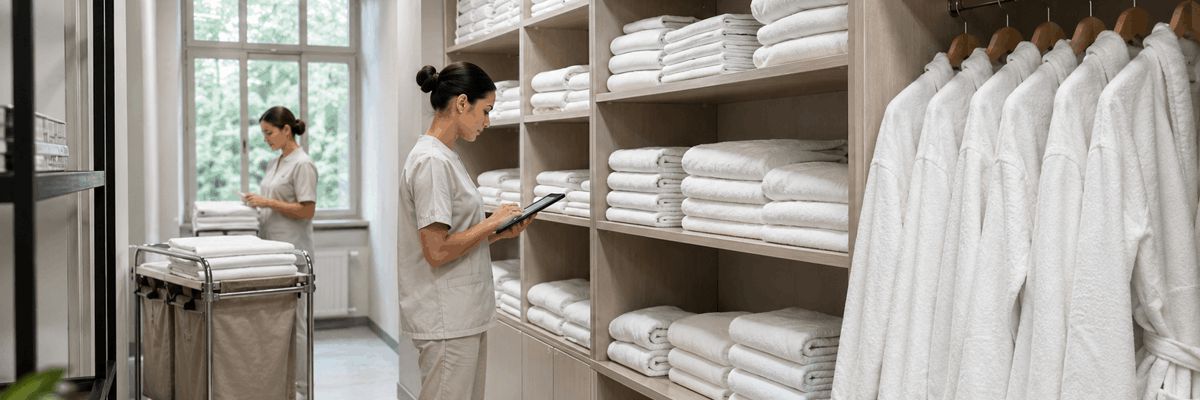
Soft Inventory Management in Sanatoriums: Why Accurate Control Matters
Soft inventory management in a sanatorium is not only a warehouse function. It directly affects guest comfort, hygiene standards, room readiness, laundry workload, purchasing discipline and the operating cost of the housekeeping department. Bed linen, towels, bathrobes, mattress protectors, blankets, pillows, curtains and other textile assets are constantly moving between storage rooms, guest rooms, medical treatment areas, wellness facilities, laundry units and housekeeping teams.
In European sanatoriums, wellness resorts, rehabilitation centres and health hotels, textile control is especially important because guests often use several facility zones during one stay: accommodation, physiotherapy rooms, spa areas, swimming pools, treatment rooms and relaxation areas. Each zone requires clean, available and properly maintained textile stock.
Comprehensive software for sanatorium automation helps establish a transparent process for controlling linen movement, towel availability, bathrobe stock, write-offs and inventory checks. Instead of relying on fragmented spreadsheets or manual notes, the housekeeping team can work with current data on stock levels, item location, condition and movement between departments.
What Soft Inventory Includes in a Sanatorium
Soft inventory in a sanatorium includes all textile and fabric-based items used in guest accommodation, wellness areas, treatment rooms and housekeeping operations. These items should not be managed as one general category, because each group has a different service life, washing frequency, replacement cycle and cost structure.
Typical soft inventory categories include:
- Bed linen: sheets, duvet covers, pillowcases, mattress protectors and complete linen sets for guest rooms.
- Towels: bath towels, hand towels, foot towels, pool towels, spa towels and treatment-room towels.
- Bathrobes and guest textile items: bathrobes, blankets, plaids, bed covers and premium textile items for higher-category rooms or wellness zones.
- Long-use soft assets: pillows, duvets, curtains, mattress covers, textile protectors and other items that require condition monitoring over time.
This structure allows the housekeeping department to control not only the total quantity of textile assets, but also their intended use, location and suitability for guest service.
Organisation of Linen Operations in a Sanatorium
The organisation of linen operations should reflect the real structure of the facility. A sanatorium may have a central linen store, floor storage rooms, laundry collection areas, clean linen distribution points, treatment departments, spa zones, swimming pool facilities and external or internal laundry services.
A controlled linen process usually includes receiving new stock, issuing clean items to departments, collecting used linen, transferring items to laundry, receiving clean items after washing, sorting by condition, returning items to circulation and removing worn items from service. Every movement should be recorded by item category, quantity, department, storage location, date and responsible employee.
When this process is not organised, the facility faces recurring problems: shortages in some departments, excessive stock in others, unclear responsibility for losses, delayed laundry returns, excessive purchasing and unreliable stock records. Proper organisation of linen operations reduces these risks and creates a clear basis for cost control.
Linen Management in Sanatoriums
Linen management in sanatoriums should answer practical operational questions. How many clean sets are available for current occupancy? How much linen is in laundry? Which departments have enough towels? Which bathrobes are ready for issue? Which items are damaged, stained or no longer suitable for guest use? Which categories require purchasing before the high season?
For this reason, linen should be tracked not only by quantity, but also by movement and condition. The housekeeping department needs to record receiving, issue, return, laundry transfer, laundry return, internal movement, repair, sorting, write-off and stocktaking results.
General stock figures are not enough. A sanatorium may have a sufficient total number of textile units but still lack specific items: bathrobes in certain sizes, pool towels, mattress protectors for one building, or complete bed linen sets for a particular room category. Detailed accounting helps avoid this mismatch.
Tracking Linen Movement from Storage to Laundry and Back
Linen movement is the core process of soft inventory management. It shows where textile assets are located, how quickly they move through the laundry cycle and where losses or delays may occur.
A typical movement cycle starts when clean linen is issued from the central store to a floor storage room or housekeeping team. After guest use, the linen is collected, sorted and transferred to laundry. After washing and drying, it returns to clean stock, is checked for condition and is either sent back into use or separated for repair, downgrade or write-off.
Each stage should be recorded. Without movement tracking, the facility may know how much linen was purchased, but not where it is now, how much is actually available, how much is in laundry, and how much has become unusable. This creates inaccurate purchasing decisions and increases the risk of shortage during high occupancy.
Towel Management in Sanatoriums
Towel management requires special attention because towels have high turnover and are used across many areas. In a European wellness or rehabilitation facility, towels may be required in guest rooms, hydrotherapy areas, swimming pools, spa rooms, treatment departments, gyms and relaxation zones.
Towels should be separated by purpose. A guest-room towel, a pool towel and a treatment-room towel may look similar, but they usually have different usage rules, washing frequency and replacement expectations. If all towels are recorded under one general stock line, the housekeeping team cannot see where shortages actually occur.
Accurate towel management helps control consumption per guest, per room, per department and per service zone. It also helps detect unusual losses, excessive use, poor return discipline or delays in the laundry cycle.
Bathrobe and Guest Textile Control
Bathrobes are usually more expensive than standard linen and require more precise control. They may be used in premium rooms, medical wellness packages, spa areas, bath complexes or rehabilitation departments. They can also differ by size, quality level and intended use.
Bathrobe stock should be monitored by quantity and condition. Some bathrobes may be new, some in active use, some in laundry, some awaiting repair, and some ready for write-off. If these states are not separated, the stock balance may look sufficient while the actual number of guest-ready bathrobes is too low.
For management purposes, it is useful to analyse bathrobe wear rate, loss frequency, department-level consumption and replacement needs. This allows the facility to maintain a consistent guest standard and avoid urgent purchasing.
Stock Control for Linen and Soft Inventory
Stock control should cover all locations where textile assets may be held. In a sanatorium, linen and other soft inventory can be located in the central store, floor storage rooms, guest rooms, treatment departments, laundry, sorting areas, repair zones and write-off areas.
The main purpose of stock control is to show the actual availability of usable items. A high total stock balance does not always mean that the facility is ready for occupancy. Part of the stock may be in laundry, some items may be damaged, and some may be located in the wrong building or department.
Key stock control indicators include:
- Available stock in the central store. This shows how much clean and usable inventory is ready for issue.
- Stock by department or building. This helps control distribution between floors, treatment areas, spa zones and other service points.
- Items in laundry. This shows how much inventory is temporarily unavailable.
- Items awaiting sorting, repair or write-off. This separates usable stock from items that should not be issued to guests.
- Minimum stock level by category. This helps plan purchasing before shortages appear.
- Variance after stocktaking. This helps identify losses, recording errors, mixed items and weak control points.
Regular control of these indicators supports stable service quality and helps the housekeeping manager make decisions based on actual data.
Linen Write-Off Procedures
Linen write-off is an important part of soft inventory management. It should not be treated only as a formal accounting action. For the housekeeping department, write-off data shows how quickly textile assets wear out, where losses occur and whether washing, storage and usage processes are organised correctly.
Common reasons for linen write-off include wear, stains, fabric damage, loss of appearance, non-compliance with hygiene standards, laundry damage, incorrect storage, shortage or loss. Each reason should be recorded separately, because different causes require different management actions.
If write-offs increase, the reason is not always normal wear. The problem may be overloaded laundry equipment, incorrect washing cycles, poor sorting, insufficient textile stock, weak return control, staff errors or inappropriate storage conditions. Analysing write-off reasons helps the management team improve processes instead of simply increasing purchases.
Stocktaking and Inventory Checks
Stocktaking verifies whether recorded stock matches the actual quantity and condition of soft inventory. It should cover not only the central linen store, but also floor storage rooms, laundry areas, guest-room reserves, treatment departments, spa zones and other locations where textile items may be kept.
During stocktaking, quantity is not the only important factor. The condition of items must also be reviewed. Some items may still exist physically but no longer be suitable for guest use. If they remain in active stock, the records overstate real availability and create a false sense of readiness.
Regular stocktaking helps identify shortages, excess stock, mixed categories, unrecorded movement, damaged items and obsolete stock. The more accurately daily movements are recorded, the easier and faster the stocktaking process becomes.
Common Mistakes in Soft Inventory Management
Many problems in linen operations are caused not by lack of stock, but by lack of accurate data. When records are kept manually or separately by each department, the housekeeping manager receives only a partial view of the process.
Common mistakes include:
- Recording all textile items as one general category. This makes it impossible to identify shortages by linen type, towel type, bathrobe size or usage area.
- Not recording movements between storage, laundry and departments. This creates differences between accounting records and actual stock.
- Writing off linen irregularly. Unusable items remain in stock records and distort availability.
- Not separating towels and bathrobes into dedicated groups. High-turnover and high-value items become difficult to control.
- Not linking stock levels to occupancy. The facility may appear well supplied but still lack enough clean items during peak demand.
- Checking only the central store during stocktaking. A large part of the inventory may be in departments, laundry or temporary storage areas.
These mistakes can be reduced by using a single system of records and a clear movement process for all textile assets.
Automation of Soft Inventory Management
Automation helps move soft inventory management from approximate manual control to a data-based process. This is especially relevant for sanatoriums, where linen, towels and bathrobes move continuously and the actual requirement depends on occupancy, laundry timing, treatment schedules, seasonality and service standards.
A good system should show stock by location, record receipts and issues, track transfers to laundry, record returns after washing, support write-off procedures and simplify stocktaking. This gives the housekeeping manager a current view of item availability and helps detect problems before they affect guest service.
Automation also improves responsibility. When movements are recorded by department and employee, it becomes easier to investigate shortages, control return discipline and evaluate the quality of housekeeping operations.
Management Indicators for Housekeeping Control
The housekeeping manager should monitor not only physical stock, but also operational indicators. These indicators help understand whether the linen operation is stable and whether the facility is prepared for current and expected occupancy.
Important management indicators include stock by category and location, quantity in laundry, write-off rate, towel consumption per guest or room, bathrobe availability by size, shortage levels after stocktaking and compliance with minimum stock levels. These indicators help plan purchases, adjust issue standards, detect excessive consumption and improve laundry scheduling.
When the manager has access to these figures, decisions become more precise. Purchasing is based on real need, not estimates. Write-offs are analysed by cause. Shortages are identified by location. Laundry delays become visible before they create room-readiness problems.
How to Strengthen Linen Control in a Sanatorium
Improving linen control begins with classification. Bed linen, towels, bathrobes, pool textiles, spa textiles and long-use soft assets should be separated into clear accounting groups. Each group should have its own movement rules, minimum stock level and replacement logic.
The next step is movement discipline. Every issue, return, laundry transfer, internal movement and write-off should be recorded. This allows the housekeeping team to find discrepancies during the process, not only at the end of the month.
The third step is linking stock data with occupancy and service requirements. If occupancy is expected to increase, the facility should know in advance whether it has enough clean linen sets, towels and bathrobes, taking into account the laundry cycle and items temporarily unavailable for use.
Conclusion
Soft inventory management in a sanatorium is essential for stable room preparation, reliable laundry operations, guest comfort and cost control. Linen, towels, bathrobes and other textile assets must be managed by category, location, movement and condition. Without this level of control, the facility risks shortages, excessive purchasing, unclear write-offs and inconsistent service quality.
Housekeeping Automation for Sanatoriums helps create a unified process for controlling linen movement, stock balances, laundry transfers, write-offs and inventory checks. It gives the housekeeping department accurate data, reduces losses and supports a consistent standard of guest service across accommodation, wellness and treatment areas.